

Make No Mistake: Andy Burnham Is Here To Finish The Job Keir Starmer Couldn't
Originally published on FaceBook 17th November 2026, Helen Buzdugan, True To You Careers, discusses the political policy decisions being taken by the Government that will have a major detrimental
effect
upon those with disability and with SEND issues.
(Links to Government reports added by unionsafety - ed.)
 In July 2025, disabled people, campaigners and a disappointingly small number of Labour MPs forced Starmer to drop his PIP cuts.
Burnham's job is to push them through. Today’s Milburn report hands him part of the plan. Starmer and Reeves sold us austerity like a dose of cod liver oil. We knew it was bitter and we spat it out.
Burnham sells it like a bag of candy floss.
I confess the candy floss even worked on me, albeit ever so fleetingly. I'm a Mancunian, and when he became prime minister I allowed myself the teeniest smidgen of hope. He promised to “turn the page on 40 years of neoliberalism”. But disabled people have learnt not to trust a Labour promise.
When those PIP cuts were dropped from Labour's welfare bill under Starmer, I wrote that the government had just kicked the grenade down the road. And here we are.
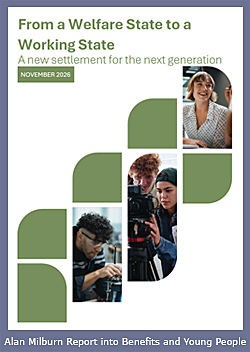
The Milburn report, published today, recommends that for under-25s, the health element of Universal Credit is abolished and PIP is replaced with a new “Additional Cost Allowance”, only for those whose extra costs are “well established, significant, and ongoing”. Young people already claiming would be moved across too, after a "personalised, time-limited transition".
Under Starmer, the case for cuts was made bluntly. The welfare bill was out of control, benefits were a barrier to work, and things would get worse before they got better.
Burnham, though, has something Starmer never had: emotional intelligence. He reads the public mood. His message is: I get it. I know you. I am you. He's politically astute too.
 He saw what didn't work for Starmer and Reeves, and he changed the language. Writing about the report in a post on Sunday, he wrapped his cuts in “a whole-childhood approach”. Young people were “the children of austerity”, he said, and it was “not their fault”. He promised they would “not face a cliff edge”, and that every young person would “grow up with hope”. More than 14,000 people liked or loved his post. They ate up the candy floss. Then, near the end, he slipped in a warning that support “will have to come with responsibilities” and benefits “must become the backstop, not the starting point”.
In his closing line, he showed his hand: “This is the sustainable way to get the welfare bill down for good”. Of course. It's always about the money. When he took over, Burnham kept Rachel Reeves's fiscal rules to keep the bond markets happy: the same markets he once said Britain should stop being "in hock to". Income tax, National Insurance and VAT are ruled out, and a wealth tax has been shelved so as not to "create new divisions".
Let's not upset the wealthy donors.
Disabled young people, on the other hand, are fair game. Milburn even says benefits "all too often" take young people "down a cul-de-sac of dependence". Thatcher's government was banging on about "dependency culture" forty years ago.
So much for the end of neoliberalism. The manufacturing of public consent for these welfare cuts has been in full swing now for more than a year. In the last couple of months it has reached fever pitch, and the main target has been young people with ADHD, autism and mental health conditions.
Headline after headline: "ADHD surge fuelled by benefits." "Child disability benefits spending doubles as mental health claims soar." "Pushy parents will take advantage of new ADHD help in schools, teachers warn." Last month I shared a photo collage of some of them, "Our lives are not your clickbait", which hundreds of you shared.
Disabled people are tired of being everyone's punching bag.
In March 2025, Wes Streeting, then Health Secretary, claimed there had been an "overdiagnosis" of mental health conditions. He then commissioned a review to examine whether normal feelings had become "over-diagnosed". Last month, the Fonagy review finally reported back: "we cannot conclude that overdiagnosis is occurring at scale". Awkward for Wes, you'd think.
 But a lot of media outlets didn't care. They carried on regardless. And now Milburn's report is taking aim at the same young people.
Those with anxiety, depression, ADHD and autism, it says, "form the majority of new PIP claimants". It names them as "particular beneficiaries" of his new system: the one that, by his own admission, will pay many of them "less cash". Yet the Fonagy review, which fed into Milburn's work, points to evidence that "increases in individual or household income improved mental health and wellbeing, while decreases worsened them".
So young people with anxiety and depression are going to "benefit" from having less money. Right.
The media has also been promulgating myths about PIP, and the Government has done very little publicly to disabuse anyone of them.
Myth one: PIP is an out-of-work benefit.
Even Milburn's own report admits it isn't: "PIP is an extra-cost benefit and is not formally conditional on being out of work. Many recipients do work."
Myth two: young people get PIP just for having a diagnosis of autism or ADHD, or a mental health condition.
They don’t. PIP is assessed on how a condition affects everyday life: things like preparing food, washing, dressing, managing medication, talking to people or planning a journey. Two young people with the same diagnosis can get very different outcomes.
More than 400,000 16 to 24 year olds now get PIP or DLA. For many of them, it's a lifeline: the taxi when public transport isn't manageable, the support, the extra costs of simply getting to college or to work. Take it away in the name of getting young people into work, and you take away the very thing that gets them there.
Burnham promised young people they would "not face a cliff edge".
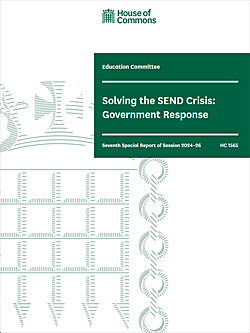
For a disabled young person who doesn't pass Milburn's new test, that's exactly what this is. Perhaps Burnham will be at the top, handing out candy floss as they go over the edge. Milburn admits that young people with additional needs are "much more likely" to become NEET. Then he "fully endorse[s]" the Government's proposed SEND reforms - changes that would restrict families' legal rights to the specialist provision their children need. He says it is "critical" that support is put in place "ahead of the changes I propose to young people's benefits".
SEND families have heard that one before.
Milburn says families “should not have to fight for a label before practical help becomes available”.
That’s already the law. Under the Equality Act, schools must make reasonable adjustments for disabled pupils, with or without a diagnosis. The SEND Code of Practice’s “graduated approach” is supposed to identify and meet needs as soon as they appear. If only that actually happened.
If it did, I wouldn’t have had to take my son out of school to home educate him last year when his school fought me over even the most basic of reasonable adjustments.
 Milburn does offer long-term support to "the small minority" where "it is already clear they will likely never be able to work".
But most neurodivergent and disabled young people sit somewhere in between. Some can work when their condition allows, but not during, say, a flare-up, a mental health crisis or autistic burnout. Many more could work, and go on working, with the right support now.
Very often that support is money: PIP covers the extra costs that level the playing field and make college or work possible. Without it, a young person who could have worked may never get the chance.
But Milburn's replacement for PIP is only for extra costs that are "well established, significant, and ongoing". Fluctuating conditions, and needs that are still emerging at 17 or 18, are exactly the ones that may not fit. Everyone else is left with a discretionary local fund.
The Milburn report spells out what happens if they can't keep up. A young person who "persistently refuses to engage" should "ultimately lose their Youth Allowance benefit". As he puts it, "a deal without consequences is not a deal".
For a young person in burnout or school distress, "refuses to engage" is a very easy label to earn. Losing PIP could very well undo everything a young person has fought very hard to get to: a college place, an apprenticeship, a bit of independence.
And then comes the great unravelling.
Young people drop out of college, or never make it there at all, their mental health suffers, and their parents are often forced to cut their hours or give up work to support them. It hits the whole family like a ten-tonne truck. For parent carers, it's a double whammy. When the parents I support have to give up work to care for their disabled children, they sometimes depend on Carer's Allowance just to get by.
But Carer's Allowance depends on the young person getting a qualifying disability benefit, such as PIP.
Milburn's 278-page report doesn't mention Carer's Allowance once. A parent-carer whose daughter's PIP was refused got in touch with me last week. I'm sharing her words with her permission.
"I am a full-time carer to my beautiful autistic daughter who also has a life-limiting genetic condition. She has been in hospital (inpatient) 6 times already this year. I had to quit my job two years ago and we have been surviving on carer's and DLA. Oh and I'm a single parent because her dad just b**ed off and left me to it. The "joke" yesterday was hearing her PIP application was declined. I honestly can't do this anymore. They've won."
Milburn’s report is called “From a Welfare State to a Working State”.
We have normalised the idea that humans are valuable insofar as they are economically productive. Many neurodivergent and disabled young people can participate in the labour market, in their own way, and with the right support. Some never will.
It should not be controversial to say that every young person and every adult caring for them has an incontrovertible right to live in a society that guarantees them dignity, care, protection and support.
And yet it is.
About Helen Buzdugan - In her own words:
People are often surprised when I say I’m a careers adviser.
A fellow careers adviser (and SEND parent) who’d been following me on social media told me she had no idea. She thought I might be a SEND advocate, a parenting coach, or maybe even a writer.
It makes sense. Because I am so passionate about systemic injustices and share my own story as a SEND parent, I don't always talk about what I actually do.
What I do is help parents in neurodivergent and SEND families figure out the “work” part of their own lives, when life at home is complicated and unpredictable. I help parents find flexible work that fits around their circumstances. I want to tell you about the conversation that set me on this path:
In 2021, after recovering from burnout, I moved from universities to working in secondary schools as a freelance careers adviser. Over the next four years, I worked in eight different secondary schools - mainstream, specialist, and a pupil referral unit.
I cared deeply about every young person I met. And especially about those I never saw, because they were unable to attend school.
One day, I was at a large mainstream school, phoning the parents of all the students in Year 11 who were not regularly attending - those I hadn't managed to reach for a careers guidance meeting in school. It was quite a long list. One parent was a follow-up. I'd spoken to her son on the phone the day before, and after initially feeling hopeless, because he'd been told (incorrectly) that he couldn't go to college without GCSEs, we ended the conversation with him excited at the possibility of starting a bricklaying course.
 I was calling his mum to explain that there was an open day at the college the next day, and ask if she might be able to take him. When she answered, in my enthusiasm, I forgot to ask if it was a good time. (Classic ADHD.) Instead I launched straight into telling her about the open day, and how it can be so helpful for students to get a sense of the place, the staff, the course, to ask questions, and see if it feels like the right place for them. Reassuring her it would feel completely different from school.
After a minute or two, she said:
"Helen, can I stop you there?"
"I really appreciate you're trying to help, but I can't take Oliver* tomorrow, because... I have to appear in court."
"Oh, I’m sorry."
She told me she was being prosecuted because of Oliver's school absence, due to autistic burnout.
How because of his absence from school, she'd lost her job.
How because she'd lost her job, she was in financial difficulty.
How all of this had affected her mental health.
Stunned, I just let her talk.
It all came out. The battle she'd had, the fines, the lack of support, the blame, the abandonment. I told her I was deeply sorry and I thought it was very wrong. She told me that no professional had ever said that to her before.
When I got off the phone, I thought of my own son, struggling in primary school, on the pathway to an ADHD assessment after many years of battling, and it struck me that this could be our family’s trajectory too.
That where we were was just the start.
The conversation with Oliver's mum was a turning point for me professionally. I was angry that - on top of all the other injustices in her story - she had lost her job and was now living in precarity. I found Facebook groups full of parents like her and parents like me, all at different stages on the same path. And I realised that I could use my many years of experience and skills as a Level 7 qualified careers adviser to help other parents like this. To support them in finding work that actually works, when family life is challenging, when it feels like everything is stacked against you.
So that's why I set up True To You Careers.
I've never felt so strongly about anything I have ever done in my career. The injustice I see here and in my work every day is what gets me out of bed in the morning. If this is you right now, and you've had to quit your job because it's unsustainable, or you're hanging on by your fingernails, you are welcome to get a free copy of my guide Finding Flexible Work.
I wrote it as a starting point for parents and carers in neurodivergent and SEND families who need work that actually works for their reality.
I'll put the link in the comments.
*Name of young person and course details have been changed.
(c) Helen Buzdugan, True To You Careers, www.facebook.com/helenbuzdugan Article: https://www.facebook.com/share/p/19F15MdAYB/
